From The Rabbi’s Study…Shabbat October 24, 25, 2025/2,3, Cheshvan 5786
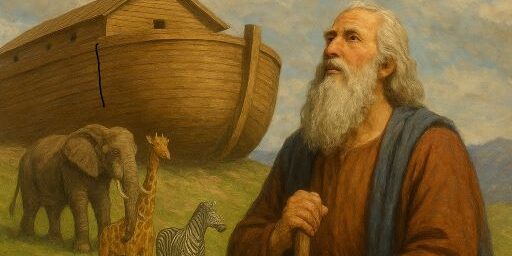
The Torah continues with the story of Noah. G-d decides to destroy the wicked world by means of a flood. G-d chooses Noah, a righteous man, and his family to be saved. Noah, his family, and the animals enter the ark and are saved from the flood. The earth dries, and G-d promises, through the symbol of a rainbow, the world will never again be destroyed by a flood. The genealogical tables of the seventy nations are presented. People build the Tower of Babel, whose construction is foiled by G-d through the confusion of their language.
Judaic concepts and values are being righteous as a virtue, a rainbow is the sign of G-d’s covenant, embarrassing another person is a transgression, and one should avoid self-aggrandizement.
One of the Mitzvot contains a Jewish tradition which holds that non-Jews are bound by seven laws, presumed to date from the time of the most righteous of gentiles, Noah! These are known as the Seven Noahide Laws and are based on the rabbinic interpretation of (Genesis 9:1-6) which contained six negative laws and one positive one:
- Not to deny G-d (as through idolatry).
- Not to blaspheme G-d.
- Not to murder.
- Not to engage in incestuous or adulterous relationships.
- Not to steal.
- Not to eat the limb from a living animal.
- To set up courts to insure obedience to the six other laws.
(Talmud Sanhedrin 56a)
Judaism regards any non-Jew who keeps these laws as a righteous person who is guaranteed a place in the world-to-come.
During the ancient world and their mythologies, a rainbow represented a weapon that their gods used in battle. The bow would be hung in the sky to represent the symbol of victory. Today when one looks at a rainbow, the shape of a bow, it faces humanity and shows no arrow could be fired to cause harm. G-d’s symbol for His covenant is that he will not destroy any living person, animal or any other living creatures with a flood.
There is a special blessing, when seeing a rainbow:
Blessed are You, Adonai our G-d, Sovereign of the universe, Who remembers His covenant, is faithful to it, and keeps His promise.”
The Haftarah, from the Book of Isaiah, comes from after the destruction of the Jerusalem Temple in 586 B.C.E. The people were in exile in Babylonia, and they were in a state of shock and despair. The prophet Isaiah offered them comfort; the promise from G-d that they will return to Zion is also a return to G-d.
G-d’s relationship to Israel is like that of husband and wife (Isaiah 54:5).
G-d’s kindness toward Israel is eternal and everlasting (Isaish 54:7).
The Torah and Haftarah are connected with these important concepts of Judaism.
As the Jewish people continue their historical journey from Noah after the flood, concentrating on material things as the ancient world did was seen by G-d as wickedness, since they did not take time to study or observe righteous behavior. Another story was the Tower of Babel, when the people were more focused on building a tall structure to reach the heavens and become like gods. It did not matter if a worker fell to their death, only the building was important.
Today, people have many items that may draw them away from realizing what G-d has given each of us, the beauty of our world, family, friends, and helping others in need. May each of us take moments to breathe, relax, and enjoy how blessed we are.
Shabbat Shalom,
Rabbi Helene Ainbinder